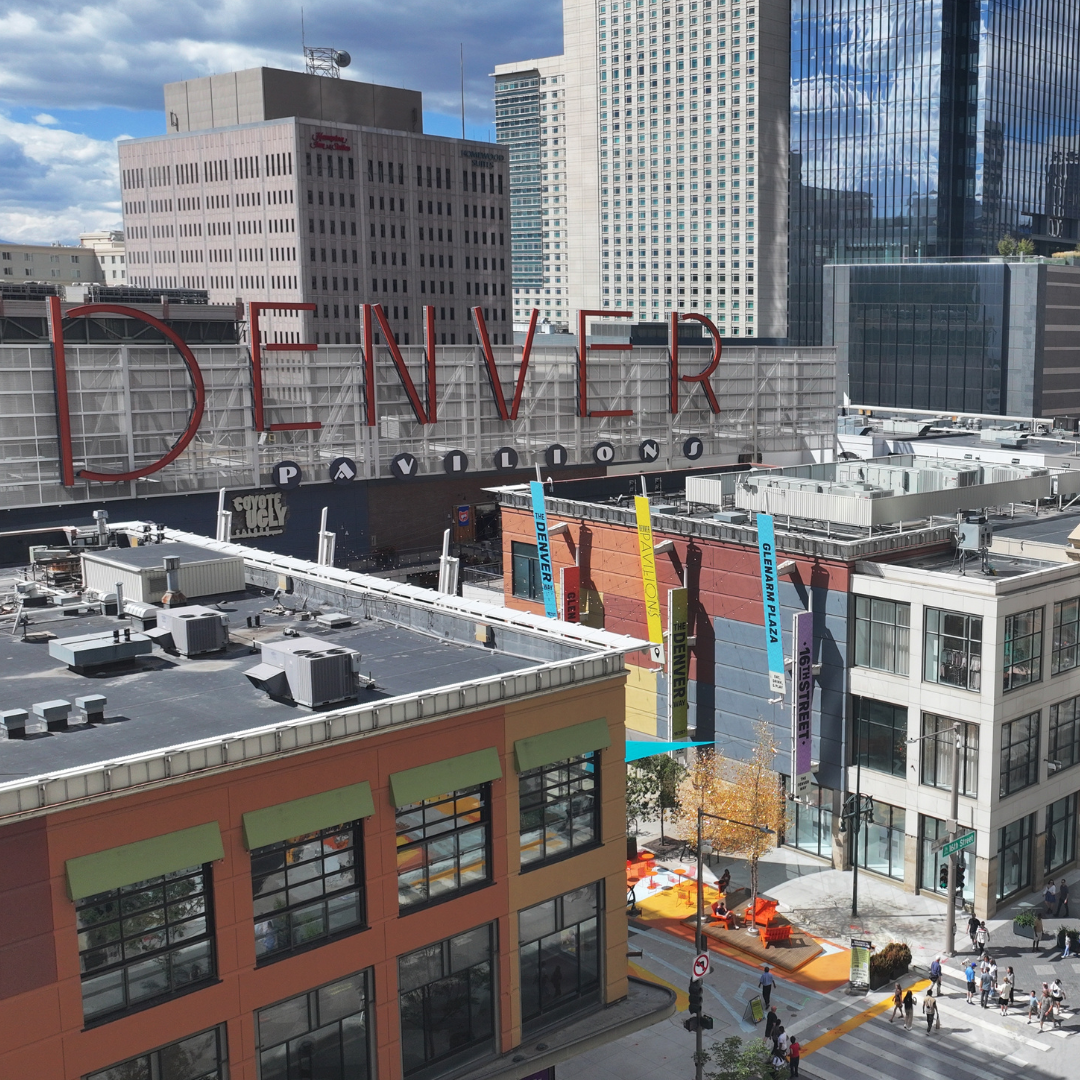
500 16th Street | Denver Pavilions & Glenarm Lots
An Urban Land Institute advisory panel on Friday delivered Denver's boldest downtown redevelopment recommendation in a generation: tear down most of the Denver Pavilions, preserve the cinema, and ring a new 109,000-square-foot signature park with two residential towers totaling approximately 1,200 units of housing.
"Our vision is big because we believe Denver can do something big," said panelist Edward Henley, founding principal and project executive at Nashville-based Pillars.
That was the through-line of the April 17 presentation, which capped a week-long engagement by ten volunteer ULI practitioners who toured the site, interviewed stakeholders, and, in panel chair Nolan Marshall III's words, "locked ourselves in a hotel for a few very long nights" to arrive at a unanimous recommendation.
Nolan Marshall III, CEO of The Social District in Downtown Los Angeles, framed the work as a repositioning, not a rescue. "Cities that have come back most quickly from similar crises didn't wait for the market," he told the audience. "They created the conditions for it."
As we previously reported, the Denver Downtown Development Authority closed in December 2025 on the 350,000-square-foot Pavilions for a reported $37 million, plus $33.5 million for the two adjacent Glenarm Place surface parking lots, and committed an additional $8 million for master planning and operations. That unified control over two full city blocks at the upper end of the 16th Street corridor, combined with the recently adopted Downtown Area Plan's explicit contemplation of replacing part of the mall with open space, gave the panel "permission" to pursue a bold move, Marshall said.
The market diagnosis was stark. RCLCO's Gregg Logan reported Q1 2026 CBD office vacancy at 38.9%, with hybrid work permanently compressing office demand and regional growth dispersing to the metro edges. HVS's Suzanne Mellen noted downtown hotel occupancy sits roughly 10 points below pre-COVID levels versus a two-point gap nationally, and only 5 of 48 hotels in greater downtown offer 400 rooms or more. Despite that, the panel explicitly rejected a convention-oriented hotel for the vacant Glenarm parcels.
A 1,000-plus-room property with the 100,000 square feet of meeting space the Colorado Convention Center currently lacks would cost $800,000 to $1 million per room in 2026 dollars, roughly $800 million to $1 billion total, and would require substantial public subsidy. "Residential development offers the strongest market-driven path to feasibility," Mellen concluded.
Kristen Morris, president of Atlanta-based Morris & Fellows, delivered the indictment of the existing retail format. "The existing building, turning in on itself, is an obsolete building form," she said. "It is not what retail wants.
They don't want to be stacked and they don't want to be hidden away from the street." Although 16th Street foot traffic has recovered to roughly 93% of 2019 levels, the Pavilions' inward-facing, multi-level configuration captures almost none of it, and retail growth has migrated to Cherry Creek, RiNo, the Highlands, South Broadway, and Union Station, all anchored by residential density, not office commuters.
Recruiting new tenants alone, Morris said, will not unlock the property's potential.
The proposed vision replaces most of the Pavilions footprint with a 109,000-square-foot publicly accessible cultural open space and retains the cinema as roughly 70,000 square feet of curated first- and second-floor space for local and emerging retail, food and beverage, performance, exhibition, and incubation, at market or below-market rents to support local operators.
Mithun's Bert Gregory and NBBJ's Christopher Beza presented a phased framework that closes Glenarm Place to through traffic, reroutes underground parking entrances to Tremont and Welton, activates the perimeter with two residential towers fronting 15th Street, and layers in 52,000 square feet of retail and 217,000 square feet of additional active and creative uses. "Great urban spaces are not voids. They are framed rooms," Beza said. "The goal is not to build a park instead of development. The goal is to build a development organized around a great public room."
Phase one restores the northeast corner, opens the park, delivers the Welton Street tower, and reactivates the cinema block.
Phase two, intentionally delayed by roughly a decade, delivers the Tremont tower and additional 15th Street retail, a deliberate timing choice that lets the public sector capture the value created by phase one before disposing of phase two. "You wouldn't want to dispose of that early, because you're missing the public sector's ability to recapture the value that's going to be created from the site," Marshall explained.
The cost estimates total between $498 million and $615 million: $8M to $15M for demolition and site work, $40M to $50M for the park, $210M to $250M for the Welton tower, and $240M to $300M for the later Tremont tower, escalated for future delivery.
The panel estimated a one-time economic impact of $380M to $450M from construction and permitting, plus $2.5M to $4M in annual additional sales tax and 20 to 50 new full-time positions once the project stabilizes. Funding options it recommended Denver explore include tax-increment financing, municipal bonding, and new-market tax credits, with naming rights on the signature park as an additional revenue stream.
The DDDA already generates roughly $4 million in annual revenue from the underground parking garage and another $1.3 million from the surface lots, a base that Bill Mosher, Denver's chief projects officer, said should mean "the DDDA would not need to use funds outside of that revenue base to help catalyze the vision."
Governance would run through a public-private partnership in which the Denver City Council approves a single master development agreement and the private sector executes.
The park itself would not become a city park but a publicly accessible open space maintained by a private steward, with the Downtown Denver Partnership as the panel's suggested operator. "This area hardly needs another overly protracted process," said panelist Mick Cornett, the former mayor of Oklahoma City, pointing to the lengthy post-pandemic rebuild of 16th Street. "It is now time for the private sector to step up and work with downtown leadership."
The cinema stays for reasons beyond adaptive reuse. Regal recently invested in upgrading screens at the property, a signal Marshall said reflects confidence in the metro Denver cinema market, further reinforced by Boulder's upcoming run as host of the Sundance Film Festival and the Paramount theatre next door. Existing Pavilions leases run from the near term through the early 2030s, Mosher said, and the DDDA will honor them regardless of the ultimate scheme. Several tenants have already initiated conversations about relocating elsewhere along 16th Street.
James Lima, co-author of ULI's 2019 Case for Open Space, anchored the economic argument in national precedent: the Indianapolis Cultural Trail's 148% assessed-value lift within one block, the Atlanta BeltLine's $9 billion in property-value gains and 8-to-1 public return, and Manhattan's High Line, which generated $1 billion in city tax revenue over 15 years. Lima framed the site as Denver's version of Cincinnati's Fountain Square or New York's Bryant Park, a new anchor that would string Union Station, Skyline Park, the Pavilions, and the Civic Center into a pearl necklace along 16th Street.
Mayor Mike Johnston, who met with the panel during its deliberations, did not hide his enthusiasm. "For many of us in the Denver urban design space, this was like the Taylor Swift album drop," he said.
ULI will deliver a formal report to the DDDA within 30 to 60 days. From there, the DDDA will evaluate, refine, and, if it moves forward, issue a request for proposals to the private development community. Previous ULI Denver panels focused on Speer Boulevard in 2022 and 16th Street in 2008, a reminder that the institute's recommendations tend to shape the corridor long after the panelists leave town.