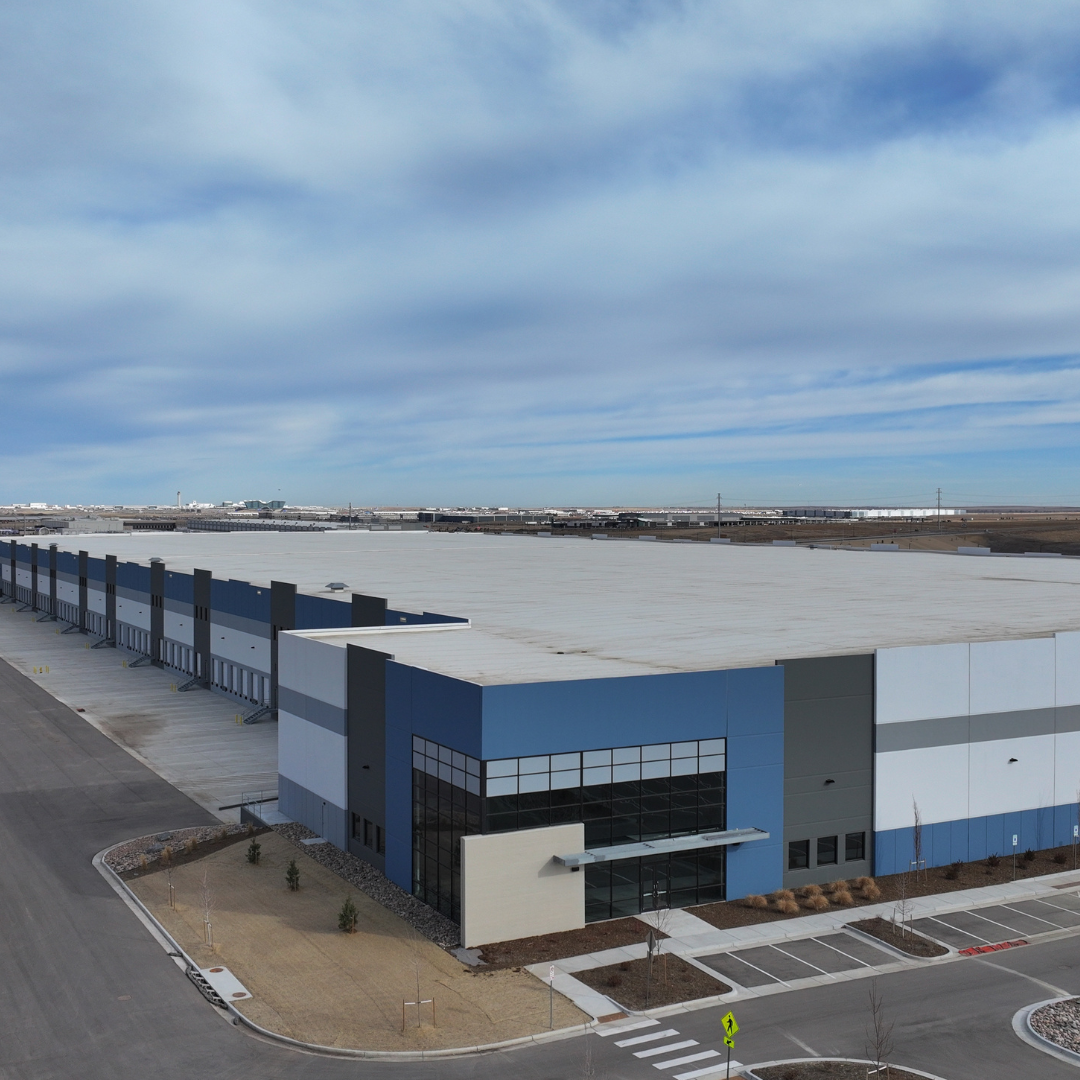
25000 East 56th Avenue, Aurora
Building 1B at Sun Empire, a 204,908-square-foot Class A industrial building in Aurora's airport submarket, has reached full occupancy. A global logistics company signed a lease for the remaining 58,767 square feet, joining an unnamed leading manufacturer that had committed to 146,141 square feet in fall 2025. The lease-up closes out the smaller of two speculative buildings delivered in the development's first phase.
Sun Empire is a joint venture between The Opus Group and Principal Asset Management, anchored on a 169-acre, multi-phase, master-planned site at the southeast corner of 56th Avenue and Harvest Mile Road. The development sits three miles from Denver International Airport with direct access to E-470 and Interstate 70, positioning it as one of the more strategically located industrial parks in the metro. Aurora's Enterprise Zone, Opportunity Zone, and Foreign Trade Zone designations add additional incentive layers for tenants considering the corridor.
"Aurora continues to experience tremendous growth as a direct result of manufacturing, healthcare and retail expansion here, and that growth is driving demand for high-quality, amenity-rich and advantageously located industrial space," said Randy Danielson, senior director of real estate development with Opus. "Fortunately, that's just what Sun Empire offers."
Opus acquired the original 316-acre site in July 2022 for $49.7 million, subsequently selling 147 acres to Philip Morris International's U.S.-based affiliate, Kairus Inc., in 2024. That land sale — one of the largest direct transactions and highest price-per-square-foot land deals in Aurora history — paved the way for PMI's $600 million Zyn nicotine pouch manufacturing campus, now under construction immediately adjacent to Sun Empire on a roughly 150-acre parcel near 48th Avenue and Harvest Road. PMI broke ground in December 2024 and began producing pouches in September 2025, with full operations expected in 2026. The deal earned a 2025 CoStar Impact Award for Sale/Acquisition of the Year.
The Zyn facility's presence adds a significant anchor to the Harvest Road corridor and has drawn additional tenant interest to the broader submarket. PMI separately leased warehouse space at 25000 E. 56th Avenue within Sun Empire to support its hiring and external warehousing operations as its Aurora campus ramped up. That relationship between the two projects illustrates how the airport submarket has evolved: large-scale manufacturing users are clustering in the area, and the supporting logistics infrastructure is filling in around them.
Building 1B was designed as a front park/rear load configuration with a 32-foot clear height, 38 dock doors, 248 vehicle parking stalls, and 56 trailer parking stalls. The building is now fully absorbed. Attention now shifts to Building 1A, the larger of the two Phase 1 structures at 625,178 square feet. The cross-docked building features a 40-foot clear height — uncommon for the Denver market — along with 112 cross-docked doors, 388 vehicle parking spaces, 91 trailer parking stalls, and dual transformers providing up to 8,000 amps of power. It also includes a built-out office suite with private offices, conference room, break room, IT room, and restrooms, and is internet-ready. CBRE's Todd Witty and Daniel Close are marketing the available space.
Opus served as developer, design-builder, architect, and structural engineer of record across both Phase 1 buildings. The firm has deepened its footprint across the Denver metro in recent years, with projects ranging from the Catalyst Industrial development in Centennial — a 188,054-square-foot shallow-bay spec building completed in April 2025 — to multifamily projects including 19Nineteen at Mile High and Kalaco Apartments near Colfax and Kalamath. The company has also recently broken ground on its first industrial project in Colorado Springs.
The Sun Empire master plan envisions up to 2.9 million square feet of industrial space across multiple phases on the remaining acreage, with individual buildings ranging from 200,000 to 625,000 square feet and the ability to expand to 1 million square feet for the right user. The site is positioned to capture demand from e-commerce, manufacturing, aerospace, biosciences, renewable energy, and warehouse and distribution tenants — sectors aligned with Aurora's broader economic development strategy. With more than 34,000 new homes planned in the vicinity and a local transportation and warehousing workforce exceeding 60,000, the corridor offers both land and labor depth that is difficult to replicate elsewhere in the metro.
Denver's industrial market ended 2025 with stabilizing fundamentals after a period of elevated vacancy. Overall vacancy across the metro sat at approximately 8.1% as of Q4 2025, according to Cushman and Wakefield data, with newer Class A product continuing to outperform older stock. The full lease-up of Building 1B in a submarket that had seen oversupply concerns near DIA is a meaningful data point as the market transitions toward a more balanced phase heading into the second half of 2026.