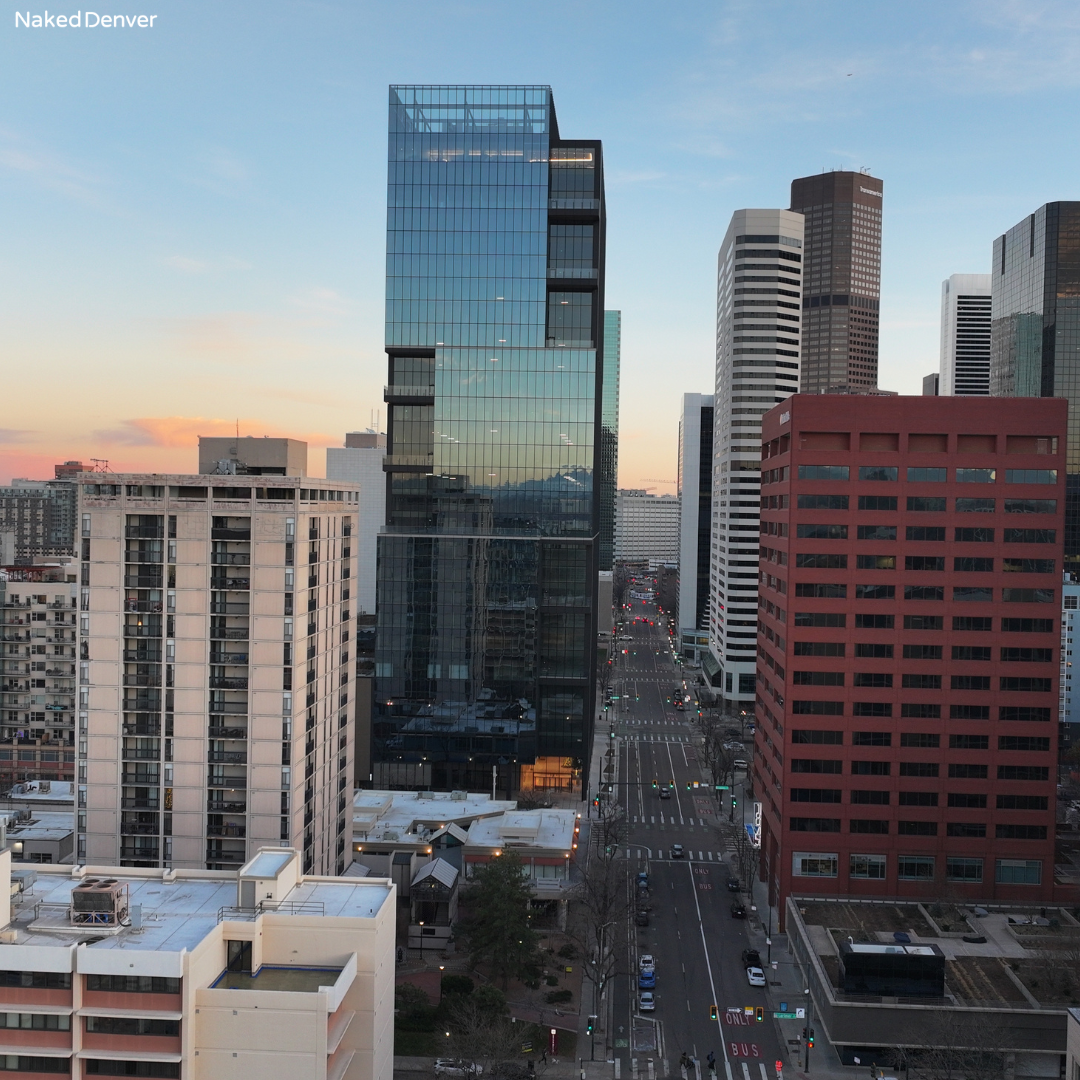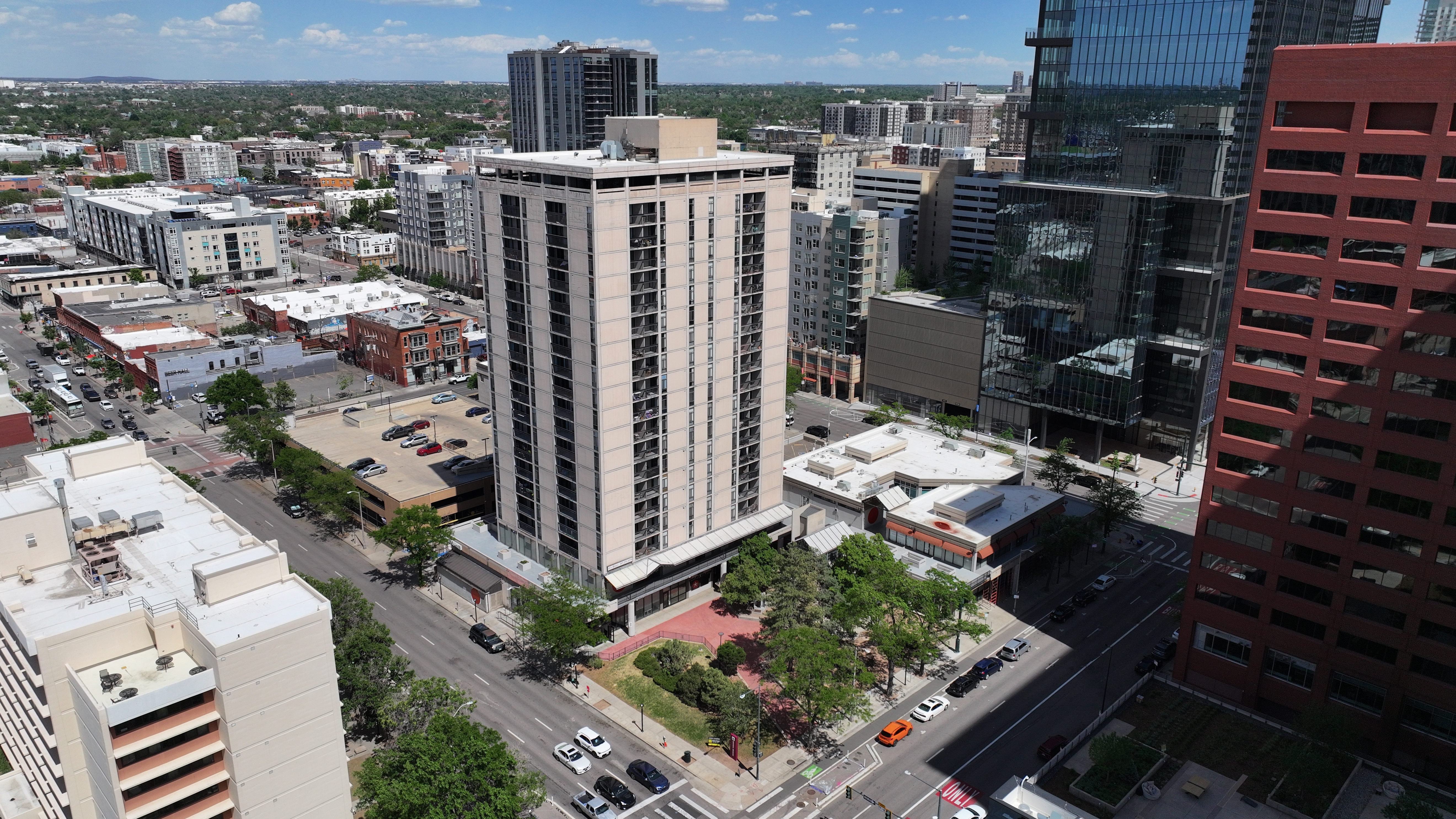
Sakura Square
The last surviving block of Denver's pre-urban renewal Japantown, has filed a roughly $30 million loan application with the Downtown Denver Development Authority. The Sakura Foundation submitted the request in October 2025 to fund structural repairs and a phased rebuild of the block bounded by 19th, 20th, Larimer, and Lawrence.
The decision lands as the same tax-increment financing mechanism that cleared Denver's Japantown corridor in the late 1960s is being asked, 57 years later, to help fund what's left.
The Past
In 1964, the Skyline Urban Renewal Project was proposed by Forward Metro, a coalition of downtown Denver business interests, as an $8 million bond issue to clear 27 blocks of LoDo and the lower Larimer corridor and replace them with office towers, hotels, retail, and structured parking. The civic frame in the proposal was blight, rundown buildings, bars and cheap hotels, low-income tenants, retail businesses run by immigrants and people of color and the implicit business case was reversing the postwar white flight that had hollowed out downtown's commercial activity as white residents and corporate tenants moved to the suburbs. Denver voters rejected the bond. The federal urban renewal program required cities to put up one-third of project cost as a local match, and the Forward Metro proposal would have funded that match through a property tax increase. Several City Council members publicly opposed the bond and led the opposition. The 1964 vote killed Skyline on the financing question.
The project survived through a combination of federal financing reform and a shift in public mood. In June 1965, the South Platte River flooded, devastating parts of lower downtown and reinforcing the visual case that the area was deteriorating. Two months later, in August 1965, downtown Denver business interests successfully lobbied for an amendment to the federal Housing Act that allowed cities to use existing capital improvement expenditures, instead of new bond money, as the local match. The principal lobbying force behind the amendment was Edwin Palmer Hoyt, publisher of the Denver Post from 1946 to 1971 and one of the most influential civic figures in mid-century Denver. The Johnson administration then ruled that Denver could count the cost of its newly built exhibition center toward the Skyline project match. The 1967 vote went forward without a property tax increase attached, was endorsed by Mayor Thomas Currigan (running for re-election), most of the City Council, and the Denver Post under Hoyt's editorial direction, and approved The Skyline Project with more than 70% of the vote. Hoyt, Currigan, and the Forward Metro coalition did not change the voters' minds. They changed the federal law so the voters would not have to pay for it.
The legal framework behind the project was the federal Housing Act of 1949, which had given American cities a standardized urban renewal pipeline: declare a project area blighted, exercise eminent domain to acquire every parcel inside the boundary, demolish what was there, and resell the cleared land to private developers selected through a city-controlled disposition process. The federal program subsidized two-thirds of the gap between acquisition cost and disposition price. In San Francisco's Japantown and similar neighborhoods across the West Coast, residents and historians have described the program as a second displacement, coming barely two decades after wartime incarceration had emptied the same blocks under Executive Order 9066. Colorado adopted its Urban Renewal Statute in 1958. Denver established the Denver Urban Renewal Authority (DURA) the same year, initially to clear smaller blighted areas in Avondale, Blake Street, Jerome Park, and Whittier. The 1967 Skyline approval authorized DURA to scale the program to 27 blocks of downtown bounded roughly by Larimer Street, 20th Street, Speer Blvd, and Curtis Street.
DURA's Skyline Land Use Map shows what the city intended to put in place of what was there. East Denver Block 65, bounded by 19th, 20th, Larimer, and Lawrence, was designated for parking. A handwritten revision note on the same document reclassified Blocks 01, 02, and the north half of Block 13 from parking to CBD Supporting Commercial. The block that became Sakura Square and the block that became Sunset Towers never appeared on a DURA map as housing, as religious use, or as a cultural anchor. They appeared as parcels planned for parking cars.
The Denver Buddhist Church had owned the four lots at 1947 Lawrence since 1938 and completed its temple chapel there in 1949. The temple sat at the geographic seam between LoDo and Five Points. Pre-Skyline Japantown stretched several blocks along the Larimer-Lawrence corridor north from the temple into Curtis Park and Five Points, with Pacific Mercantile, Granada Fish Market, and approximately thirty Japanese-owned grocery stores distributed along the spine. North of the densest Japanese American concentration, the corridor blended into the Black business and residential district that defined Five Points as the cultural heart of Black Denver from the 1920s through the 1950s.
The two communities were not in separate neighborhoods. They were on the same Larimer-Lawrence-Welton spine, a continuous Asian American and Black commercial corridor that Skyline cut in half.
DURA acquired the 27-block footprint parcel by parcel, some through negotiated sale, most through condemnation, frequently both against the same family in sequence. The Dikeou family lost at least four parcels across three East Denver blocks in a six-and-a-half-month window. Deed records from 1968-1969 show DURA as the grantee for Dikeou-owned properties at 1279 Curtis Street, 1741-1747 Curtis Street (now under the 1001 17th Street tower built in 1975), and 1916-1947 Curtis Street on Block 94, the full city block bounded by 19th, 20th, Curtis, and Arapahoe.
The Block 94 parcels were condemned in February 1969 and conveyed by May 1969. The cleared block sat as the Greyhound Denver Bus Center from 1975 until 2020, when Greyhound vacated and sold the site to a Rockefeller Group and Golub & Company joint venture for $38 million. The site is now approved for a two-tower development, with one 38-story residential tower and one 28-story office tower rising to the 400-foot zoning maximum.
These parcels sit today under office tower footprints and one of downtown Denver's last full-block development sites. DURA's 50th-anniversary report admits the Skyline project displaced more than 700 businesses, 1,600 individuals, and 95 families.
Block 65 - Sakura Square
The Japanese American Buddhist community has held continuous ground tenure on Block 65 since April 8, 1938, when Capitol Life Insurance conveyed Lots 25, 26, 27, and 28 to the Denver Buddhist Church for $4,000. The acquisition preceded Pearl Harbor by three years and eight months and Japanese American internment by three years and ten months. Colorado sat outside the West Coast exclusion zone, and the church's corporate ownership gave the parcel an institutional continuity through the war that individual Japanese American property holders on the coast did not have, since most were forced to sell under Executive Order 9066. The 1938 parcel functioned as a community anchor that survived the war, postwar resettlement, and the completion of the temple chapel at 1947 Lawrence Street in 1949. When Skyline came through three decades later, the church's four-lot footprint never sold to DURA.
DURA acquired the surrounding 28 lots of the 32-lot block from at least nine separate ownership clusters over a 22-month window. The Wilson Estate conveyed Lots 23 and 24 in December 1968 for $24,500. The Shapiro and Kaplan family co-tenancy, a Jewish American family with Max Shapiro executing his quarter-interest deed from Las Vegas, conveyed Lots 31-32 plus the northeasterly 10 feet of Lot 30 in April 1969. St. Vincent de Paul Salvage Bureau, Inc., the Catholic lay charity's thrift store operation, conveyed Lot 29 plus the southwesterly 15 feet of Lot 30 in April 1969. The Zerobnick family, administered through Joseph Zerobnick and the Jacob Zerobnick estate, conveyed Lots 3 and 4 in July 1969. Albert Rudofsky conveyed Lots 15 and 16 in October 1969. Betty C. Tappe conveyed Lots 17 through 22 in March 1970. Jesse Harrison and Marcie J. Kittay, as trustees, conveyed Lots 8 through 14 in March 1970 for $100,000, the largest stated price on any Block 65 deed.
The Inais were not bystanders to the Skyline displacement. They were prior fee owners. On July 23, 1958, Sam S. Bloom and Pizer H. Bloom sold Lots 5 and 6, then known as 1942-1944 Larimer Street, to George and Takako Inai as joint tenants for roughly $18,000 to $22,000 based on the documentary stamps. The Inais owned that ground for twelve years before DURA acquired it on October 30, 1970. John Yamasaki had conveyed adjacent Lots 1 and 2 six and a half months earlier, on April 15. George Yutaka Inai founded Pacific Mercantile Company, the Japanese grocery and dry goods store that has anchored Sakura Square since the building opened.
Pacific Mercantile's continuity on the corner, 80-plus years and four generations of the same family, now run by Inai's granddaughter Jolie Noguchi with her daughter Alyssa as the fourth generation, is not just a family business persisting through change. It is a family that bought commercial real estate in 1958, sold to the city under Skyline eminent domain pressure in 1970, and continued operating as tenants on their former ground after the temple consolidated the block in 1971. The land tenure changed twice in five months. The store stayed.
On February 1, 1971, the City vacated the interior alley running through the block by ordinance, a quiet preparatory step that consolidated the parcel into a single buildable site five weeks before the conveyance. Then on March 5, DURA Vice Chairman Sterling Kahn signed two warranty deeds conveying the 27 DURA-acquired lots to Tri-State Buddhist Church Apartments, Inc., the Colorado nonprofit the church had chartered to develop the property under the FHA Section 236 housing program. The conveyance combined the cleared lots with the church's existing four-lot parcel to produce the consolidated 32-lot Sakura Square block. The stated consideration on the face of each deed was $10, though it is widely reported $188,800 was the total consideration.
Those conditions are what make the block exist. Construction had to begin within 60 days and complete within 24 months. The block had to remain a single parcel throughout church ownership, the legal mechanism that has kept Sakura Square coherent for 50-plus years. A 24-year land-use restriction tied to the Skyline plan ran through December 31, 1995. A federally required civil rights non-discrimination covenant named the United States as beneficiary while DURA reserved a Right of Re-Entry, a reversionary interest that would have allowed the agency to take the block back if the church missed a deadline or violated a covenant. The church did not own the rest of the block in 1971 the way Pacific Mercantile owns its lease. It held a conditional fee secured by a reverter clause that DURA did not release until a Certificate of Completion recorded on May 24, 1974, about a year after the square was dedicated.
Fourteen days after signing the deeds, on March 19, 1971, Sterling Kahn stood at the podium inside the Tri-State Buddhist Temple chapel and spoke at the Sakura Square groundbreaking. Robert W. Schott photographed the ceremony. The same DURA official who had signed the conditional reverter was the public face of the community celebration. The 60-day construction deadline written into his signature began running that morning.
Block 50 - Sunset Towers
One block north across Larimer, DURA acquired Block 50 from at least seven distinct communities over a 22-month window: Chinese American, Japanese American, Mexican American, German American, Greek American, Jewish American, and Anglo American property holders, all displaced by the same federal urban renewal program.
The earliest conveyances closed in late 1968. Carlos Gutierrez, executor of the Estate of John Martinez, conveyed Lot 29 on December 2, 1968. Robert L. Bechtold, a German American at 1943-1945 Larimer, conveyed Lots 27, 28, and a sliver of Lot 29 on December 31. Bechtold's building shared an 1880s party wall with the adjacent Yick Keong Association building, the two structures physically connected on the corridor since the era of Denver's 1880 anti-Chinese riot. Paul Quintana Jr. and Sr., a Mexican American father and son, conveyed Lot 24 at 1931 Larimer on January 21, 1969. Daisy G. Howard, formerly Daisy G. Osumi, conveyed Lot 23 on February 14, 1969.
On April 10, 1969, the Yick Keong Association, a Cantonese American benevolent society incorporated as a Colorado nonprofit, conveyed Lots 25 and 26 to DURA for $27,500. Unlike nearby DURA acquisitions, which used the standard “$10 and other valuable consideration” language, this deed stated the price directly. DURA then cleared an 1880s building tied to the Bechtold party wall agreement and to a surviving Chinese American institution that still operates in Denver today.
Acquisitions continued into 1970. Abe Kraut conveyed Lot 22 in December 1969. R.E. Myrick conveyed Lots 20 and 21 on February 2, 1970, with related leasehold interests also quit-claimed. On April 1, 1970, Milton Karavites and the Estate of Alex Theodore Gatchis conveyed matching half-interests in Lots 17 through 19 for $17,500. Fred S. and Chiyeko Aoki conveyed Lots 30 through 32 on July 31, 1970.
The difference between Block 50 and Block 65 was not legal form, community presence, or commercial activity. Both blocks were working downtown corridors with multiple immigrant communities and active businesses. The difference was development corporation infrastructure on the receiving end. None of the Block 50 grantors held a corporation chartered to access HUD's Section 236 program, and none had been holding ground on the corridor since 1938 the way the Denver Buddhist Church had on Block 65. When DURA cleared Block 50, no community institution existed to bid on the assembled parcel. The block sat in DURA's inventory for nine years until 1979, when the agency conveyed the ground to Sunset Towers Inc. for federally insured affordable senior housing. The asset operates today under Volunteers of America management. Sunset Towers sits on what was Quintana, Osumi/Howard, Yick Keong, and Bechtold ground. The surface parking lot on its northern edge sits on what was Aoki and Martinez ground, Japanese American and Mexican American family property cleared in the same 22-month window that produced Sakura Square across the street, never built upon, surface parking for 56 years.
Sakura Square Construction - 1970's
Construction proceeded under FHA Section 236 financing through the early 1970s. Tri-State Buddhist Church Apartments did not hire an established institutional architect. They hired Bertram A. Bruton, one of Colorado's earliest licensed Black architects, running a young Five Points-based practice less than a decade old. The choice was geographically continuous with the choice of corridor. Bruton's practice was rooted in the same Larimer-Lawrence-Welton spine that pre-Skyline Japantown had run through. The Japanese American institutional client and the Black professional community sat in the same corridor, navigated the same Denver racial restrictions on commercial real estate and professional practice, and watched the same urban renewal program clear both their neighborhoods from the map.
Bruton drew the 20-story Tamai Tower with its textured-concrete recessed balconies, the connecting commercial structure, and a revamped exterior for the existing temple at 1947 Lawrence. Sakura Square was Bruton's institutional breakthrough. The Wellington Webb Municipal Building, Mile High Stadium, the Colorado Convention Center, and Denver International Airport came later in his career, partly because Sakura Square was the demonstration project that established his practice could deliver large-scale, federally financed work. The Japanese American community's choice of architect helped build the Black architectural practice that would later contribute to Denver's civic infrastructure. The square was dedicated in May 1973, and the inaugural Cherry Blossom Festival ran during the grand opening weekends.
The block has stayed under continuous community control across three governance structures, temple corporation, FHA 236 development corporation, and member-managed LLC, for 55 years. Charles Ozaki, the LLC chairman, is the same operator whose name appears on the 2025 DDDA loan application now under review.
The Present
The Downtown Denver Development Authority sits at the center of the largest public financing program the city has launched since Skyline. Originally created in 2008 to fund Union Station's restoration, the DDDA was expanded by ballot measure in November 2024, when roughly 78 percent of voters living near Union Station passed Ballot Measure 6A, authorizing $570 million of debt for downtown revitalization. The total repayment cost will be up to $847 million.
The authority's four funding priorities are housing, business support, activation and public spaces, and it operates through tax-increment financing rather than new taxes. As of late 2025, the DDDA had awarded $166 million of available funding, with $46 million going to office-to-residential conversions, and demand was strong enough that the authority ran four funding cycles in 2025 instead of the originally planned two. Denver City Council adopted the 2025 Downtown Area Plan in November 2025, a 20-year roadmap intended to guide growth through 2045 and double the number of people living downtown.
The DDDA secured an additional $210 million in new financing the same week and acquired the Denver Pavilions for $45 million earlier in the fall. The Sakura Foundation's roughly $30 million application now sits inside the same pipeline that funded the Pavilions acquisition, office conversions across the financial district, and the largest public reinvestment program downtown Denver has seen since the project that cleared the corridor in the first place.
Pacific Mercantile Company has been a Denver fixture since 1945, when George Inai founded it on Larimer Street after his release from internment, and has operated continuously inside Sakura Square at 1925 Lawrence since the block was built in 1972. The business is now run by Inai's third-generation grandchildren, with the fourth generation coming up. Tamai Tower's 199 units exited HUD subsidy in 2014 and now operate market-rate under Cornerstone Apartments. The Tri-State Denver Buddhist Temple congregation, Sakura House, JJ Bistro, and A Cut Above occupy the rest of the block. The commercial building is currently scaffolded for structural repairs.
The DDDA loan application filed in October 2025 covers structural work first, then a phased rebuild of the Buddhist Temple wrapped by new residential and retail, designed by Pritzker laureate Shigeru Ban with Nichols Partnership leading development.
The development cluster around Block 65 is what makes the financing question urgent. 1900 Lawrence is a new 30-story Class A office tower in lease-up directly across 19th Street. The Greyhound redevelopment one block southeast is proposed for two 400-foot towers. Coors Field is three blocks northwest. The Arapahoe Square Urban Redevelopment Area, rezoned in 2016 to permit point-tower buildings up to 30 stories, sits across 20th Street on the block's northeast edge. Sakura Square sits at the seam between LoDo and Arapahoe Square, and every direction the wind blows is a different redevelopment vector.
Sunset Towers at 1925 Larimer is not a separate building that happens to sit nearby. It is also a Skyline disposition parcel. DURA conveyed Lots 17 through 32 of East Denver Block 50, including Lots 25 and 26 that had been the Yick Keong Association's ten years earlier, to Sunset Towers, Inc., a California nonprofit headquartered in Moraga, on May 15, 1979 at Reception 1979028561, with HUD insuring a $3.7 million construction loan recorded the same day.
The block sat in DURA inventory roughly nine years longer than Block 65 before a sponsor could be found to execute it. Volunteers of America Colorado took control of the property in 2012 through a successor LP. The 100 units of federally subsidized senior housing inside Sunset Towers serve many of the Asian American seniors who treat Sakura Square as their everyday cultural and commercial center. Sunset Towers and Sakura Square are two halves of the same urban renewal compromise, separated by Larimer Street and by ten years of inventory time. The Asian American seniors living at Sunset Towers today occupy ground that was cleared from a Chinese American benevolent association in 1969 and sat empty for a decade before federal financing arrived to put a building back on it.
The Potential
The DDDA application is the first time in 55 years that the same urban renewal financing apparatus that built downtown Denver's office tower core is being asked to fund the preservation of a community institution inside the cleared footprint. The community is the applicant, not the obstacle. The capital stack is more sophisticated than what Tri-State Buddhist Church Apartments, Inc. assembled in 1971: Shigeru Ban Architects, Nichols Partnership, the Sakura Foundation's existing nonprofit infrastructure, and a roughly $30 million ask against a roughly $404 million remaining DDDA fund balance with more than 100 competing applications in the pipeline. The cultural component is no longer optional.
The 2025 Sakura Foundation that holds the DDDA application is institutionally larger and more legally sophisticated than the 1971 Tri-State Buddhist Church Apartments development corporation, and the city it is negotiating with has more reasons to say yes: preservation of a designated cultural district, an existing development cluster that benefits from anchor activation, and a public political environment that has been increasingly explicit about the asymmetry of who survived urban renewal and who did not.
We identified two adjacent parcels that could see future investment beyond what's included in the current DDDA application: the Tamai Tower parking structure on Block 65 and the Sunset Towers surface lot directly across Larimer on Block 50. The surface lot is the same ground DURA acquired from the Aoki family in 1970, the same family that later operated Akebono Restaurant inside Sakura Square. The lot is currently controlled by Sunset Towers VOA Affordable Housing LP, the VOA Colorado-affiliated entity that took the building in 2012. It is not held by any community institution rooted in the Chinese American or Japanese American downtown community.
The opportunity that comes into focus when you stand on Block 65 and look across 20th is not generic redevelopment. It is the chance to restore community land tenure to a block that Denver cleared from a Chinese American institution in 1969 and never replaced with one. A coordinated arrangement between the Sakura Foundation and Volunteers of America Colorado, facilitated by the same DDDA financing instrument now under review for the Block 65 application, could extend Sakura Square's community-controlled footprint across Larimer and onto the parcel from which Yick Keong, Aoki, Osumi, and others were cleared. The result would be a two-block downtown Asian American institutional district anchored by a new Buddhist temple on Block 65 and a community-controlled wrap on Block 50.
The DDDA decision on Sakura Square is the first half of the question. The Block 50 surface lot is the second half, still speculative, but a real possibility if the right stakeholders and coordination come to the table. Both halves sit inside Denver's hands.