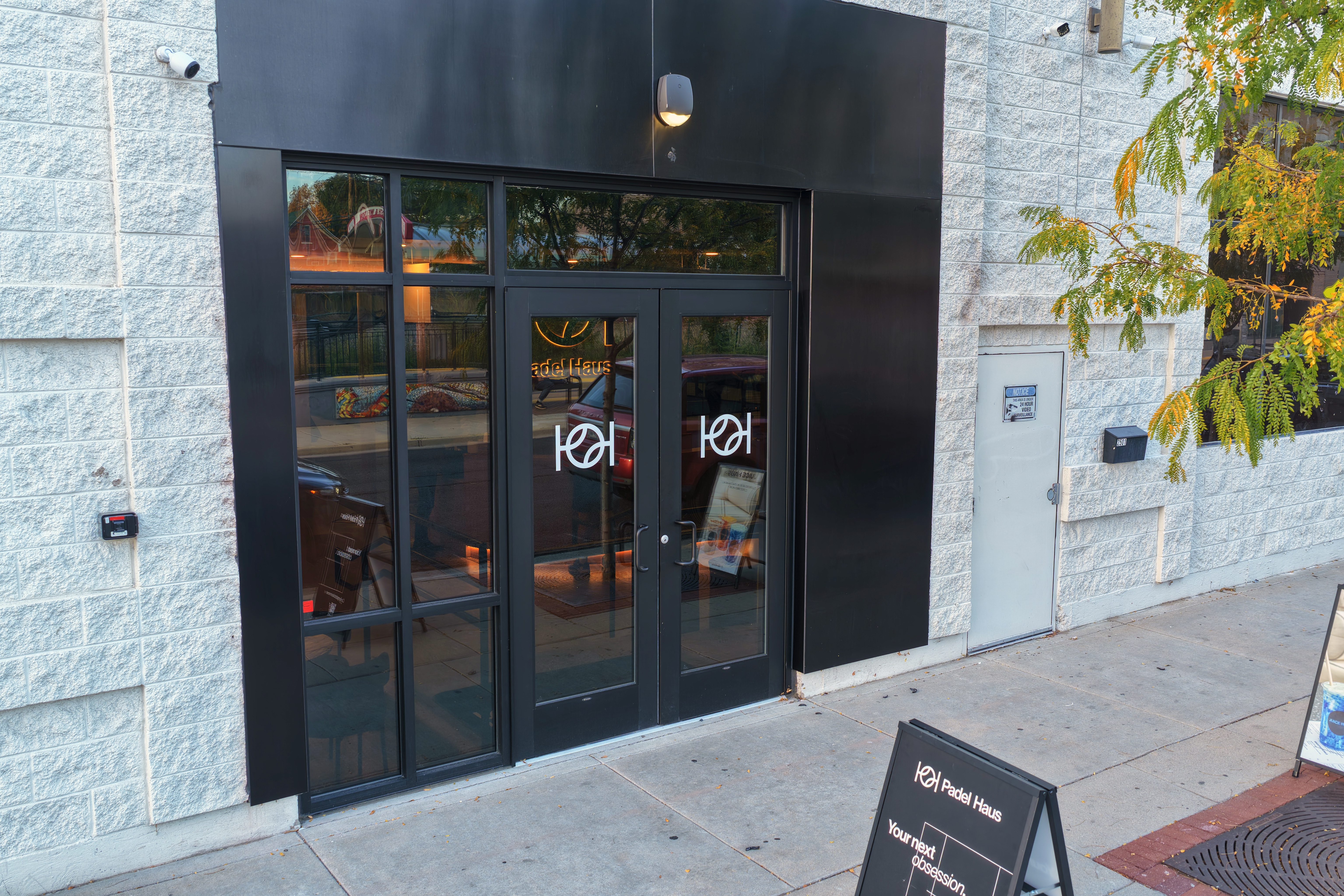
2501 Welton Street
A former warehouse in Denver's Five Points neighborhood has found new life as a destination for one of the world's fastest-growing racquet sports. Padel Haus is now open at 2501 Welton Street, bringing five indoor padel courts, a cafe, coworking space and a community-focused social experience to a 24,000-square-foot building directly across from the 25th-Welton light rail station.
The New York-based operator's first location west of the Mississippi River is designed to be more than a place to play. With spaces to work, socialize, grab a drink and meet new people, Padel Haus is introducing Denver to a club experience centered on building connections through sport.
We toured the facility in October and sat down with Club Director Jake Ledger to learn more about the sport, the transformation of the building and the company's vision for building a padel community in Denver.
Founded by Santiago Gomez, Padel Haus opened New York City's first padel club in Williamsburg in 2022. The company has since expanded to six locations, including three in New York, with Denver representing an important step in its geographic expansion.
The club occupies a former Deep Rock Water storage warehouse along Welton Street. Padel Haus signed its lease in 2024 and invested millions of dollars transforming the industrial building into a modern recreational and social destination.
Site selection came down to two important factors: ceiling height and proximity to downtown. Padel requires substantial vertical clearance for lobs and overhead shots, eliminating many conventional retail and office spaces from consideration.
The single-story brick warehouse offered ceilings of 25 feet or more while providing an urban location within walking distance of downtown and convenient access to public transportation.
"Our roots are in New York City, so we're very much a club that wants to be a part of the city rather than the suburbs" Ledger explained.
While the exterior maintains much of its original industrial character, the interior has been transformed into a contemporary club with a hospitality-driven atmosphere. Five indoor courts anchor the space, while a mezzanine lounge overlooks the action below.
The upper level features comfortable seating, a large television that typically plays padel matches and occasionally Broncos games, and noise-canceling phone booths for members and visitors who need to take calls or work remotely.
Additional amenities include coworking areas, a small gym and locker rooms finished to a luxury standard. The combination creates an environment where visitors can spend several hours, whether they are playing, working or simply enjoying the atmosphere.
"If your schedule allows, you can hang out all day long here" Ledger said.
A central part of that experience is Juice Haus, the club's in-house cafe. Serving coffee, sandwiches and light bites, the cafe provides a gathering place for players before and after matches. The club also holds a liquor license, allowing visitors to enjoy a post-match beer while catching up with friends or watching the action on the courts.
Rather than operating solely as a refreshment counter, Juice Haus is intended to be part of the club's social experience. Players can finish a match, grab something to eat and continue spending time together without leaving the building. For those visiting alone, the shared spaces and organized activities provide opportunities to meet others with similar interests.
The community aspect is particularly important for a sport that remains relatively new to many Americans.
Padel combines elements of tennis and squash, using the scoring and net play of tennis on a smaller court enclosed by glass walls. Unlike traditional tennis, balls can rebound off the glass and remain in play, creating longer rallies and a different style of competition.
The enclosed court also changes the importance of power. Hard-hit shots can rebound back toward opponents, placing a greater emphasis on positioning, strategy and teamwork.
"Once you get that first feeling of being able to play off the glass and extend the point, it really gets people hooked" Ledger said.
Although the sport has an established following in Europe and South America, its growth in the United States is relatively recent.
Ledger attributed part of the country's slower adoption to the racquet sports industry's heavy investment in pickleball facilities, while international markets continued developing padel clubs.
Denver's existing racquet sports community was one of the reasons Padel Haus selected the city. Tennis, platform tennis, squash and pickleball players often have skills that translate naturally to padel, creating a potential audience already familiar with competitive racquet sports.
However, previous experience is not a requirement, and the club is actively introducing first-time players to the game.
Padel Haus is not a members-only facility. Intro to Padel classes are offered six to seven times per week, with morning, evening and weekend sessions designed to accommodate different schedules. Demo rackets and balls are provided, allowing newcomers to try the sport without purchasing equipment.
Visitors can also book courts, participate in open play and register for clinics through the Padel Haus app. Memberships are available for those who want additional perks and discounted pricing, but visitors do not need to join to participate.
The programming creates opportunities for people to get involved regardless of their experience level or whether they already know someone at the club. Introductory classes, group activities and open play help turn a sport that might initially seem unfamiliar into an accessible social experience.
Padel Haus also recruits coaches from overseas, bringing experience from countries where the sport has been played for decades. That international influence helps introduce players to the techniques and culture associated with padel's more established markets.
Denver’s newest Padel Haus marks the adaptive reuse of a former industrial space and introduces a fresh recreational concept to the city’s urban core, transforming a storage facility into an active destination that draws visitors to Welton Street beyond traditional business hours.
With five courts, accessible introductory programs and amenities that invite people to stay and connect, the facility aims to be more than a racquet sports venue.
The goal is to create a welcoming place where residents can discover a new sport, build friendships and become part of a growing community, whether they visit for competition, a first lesson or simply a coffee overlooking the courts.