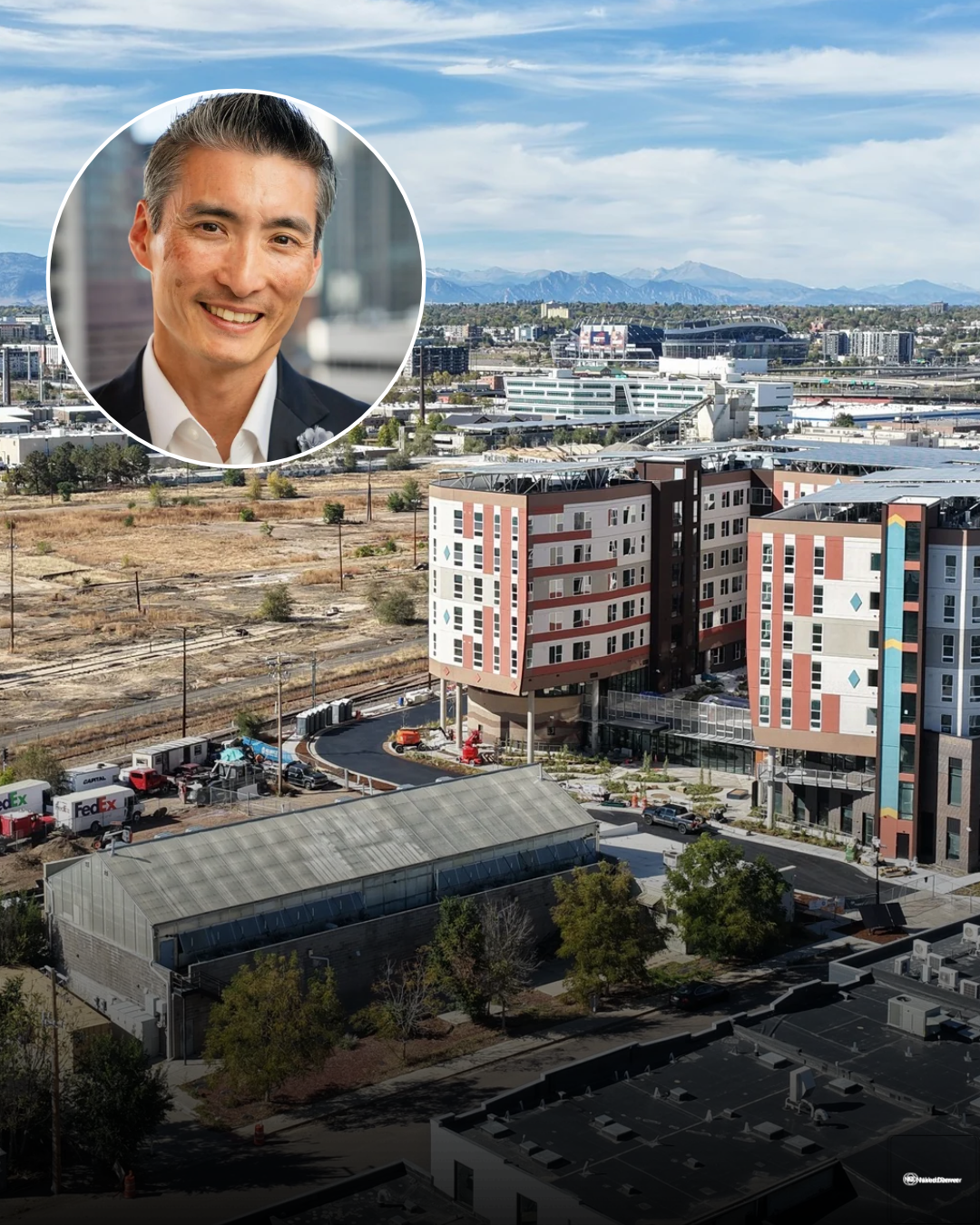
Kenneth Ho becomes executive director of the Denver Urban Renewal Authority on December 1, 2026, succeeding interim executive director Bill Pruter, DURA announced.
Ho joins DURA from Fitzsimons Innovation Community, where he was chief operating officer. His background includes real estate development, investment and urban planning, and he previously chaired the Denver Planning Board.
Ho told Naked Denver he plans to listen before he sets a neighborhood investment agenda.
“My first priority is to listen and learn from Denver’s communities, businesses and public and private sector partners to better understand where the needs and opportunities are greatest,” he said.
Founded in 1958, DURA finances redevelopment mainly through tax increment financing(TIF). Within a designated area, TIF sends a portion of future growth in property or sales tax revenue toward eligible project costs. It doesn’t raise tax rates, but it does commit future public revenue to a specific project or area. An approved reimbursement cap isn’t money already paid, and a proposal under review isn’t a final funding agreement.
Lowry Air Force Base closed in 1994, and DURA approved an urban renewal plan for the site in 1998. The agreement supported $72.5 million in bonds issued by the Lowry Redevelopment Authority and repaid with property tax increment, helping pay for demolition, roads, parks, open space and schools across the nearly 1,900-acre site.
Lowry now has about 4,500 homes, 1.8 million square feet of office space and 800 acres of parks and open space.
Stapleton International Airport closed in 1995, and DURA approved its urban renewal plan for the site in 2000. DURA reimbursed $462 million in bonds through property and sales tax increment, money that helped build roads, parks, fire stations and schools across the roughly 4,700-acre redevelopment now called Central Park.
The financing ran on a 25-year term through 2025, and DURA was wrapping up the final Stapleton bond payments when longtime executive director Tracy Huggins announced her departure last December.
With that financing complete, future tax growth in Central Park goes to the city, schools and other taxing entities instead of redevelopment costs.
Recent deals have focused on individual buildings and sites. In June 2026, City Council approved up to $15.5 million in TIF reimbursement to restore the Rossonian in Five Points as part of a larger hotel development.
In RiNo, EDENS scaled back its plan after the housing component proved hard to finance. In September 2025, council approved a retail-focused phase and cut available TIF reimbursement from $19.5 million to $9.25 million. Housing could still come in a later phase.
In Northeast Park Hill, DURA has proposed reinvesting about $8.4 million in TIF proceeds across seven projects. They include community facilities, commercial properties, environmental work and affordable homeownership. Each agreement still requires due diligence and final board approval.
At Dahlia Street Apartments, Urban Land Conservancy proposes replacing 36 income-restricted rental apartments with 36 permanently affordable townhomes for sale. Current residents would have to relocate. ULC says it would help them search for housing, pay for the move and cover some initial rent.
At Park Hill Shopping Center, Holly Market’s operator has asked for repairs and refrigeration upgrades so the store can sell more fresh food. Separately, a property co-owner has proposed a grocery in the former Horizon Lounge. Denverite reported in October that potential DURA funding was paused because of ownership and tenancy disputes.
The Denver Broncos have requested a conditions study of their proposed Burnham Yard stadium site and the surrounding properties. The study is an early step toward urban renewal assistance and doesn’t by itself approve a stadium TIF package.
The city is also finishing the Burnham Yard Small Area Plan, a 20-year policy guide for the 58-acre railyard and the La Alma-Lincoln Park and Baker neighborhoods around it.
The draft came out Oct. 14 and includes recommendations on affordable housing, protecting residents and businesses from displacement, and new trail and transit connections.
It doesn’t approve any development, and City Council is expected to take it up in early 2027.
On displacement, Ho acknowledged the challenge.
“Displacement is a significant challenge, and it’s important that redevelopment efforts consider the residents and businesses that make our neighborhoods what they are,” he said. “Ultimately, we want reinvestment to strengthen existing neighborhoods and create opportunities for the people and businesses that are already part of them.”
He said getting involved earlier would help DURA understand what a project needs before decisions are locked in.
“Getting involved earlier isn’t necessarily about changing the outcome of a project. It’s about making sure we’re asking the right questions from the beginning,” he said.
When Ho starts December 1, he’ll oversee an agency with major projects in motion and a long track record of reshaping Denver neighborhoods.