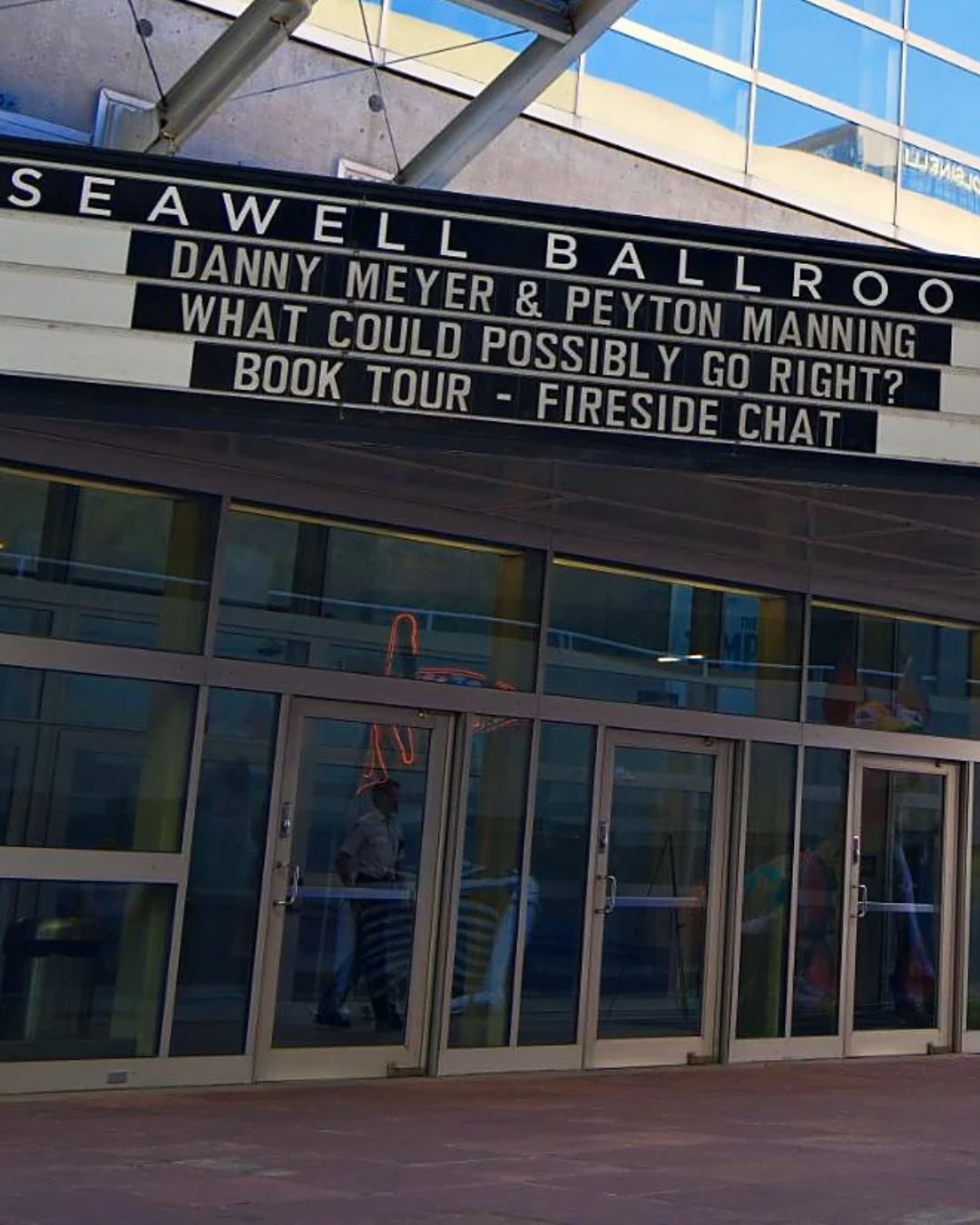
On Tuesday, Nov. 3, one of the country's most influential restaurateurs came to Denver to discuss how food, hospitality, and thoughtful operators can transform places into community gathering spots.
We usually cover the deals behind Denver's buildings, but great real estate is ultimately about what happens inside the walls and in the spaces between them.
Danny Meyer, founder of Shake Shack and Union Square Hospitality Group, sat down with Peyton Manning at the Seawell Ballroom in the Denver Performing Arts Complex to discuss his new book, What Could Possibly Go Right?
The event was presented by 1st Street Farms, the Littleton restaurant and event project, in partnership with EatDenver.
Host Peter Newlin, CEO of Gastamo Group told the crowd it was the biggest audience of any stop on Meyer's tour.
Newlin is CEO and partner of Gastamo Group, the Denver company behind Park Burger, Homegrown Tap & Dough, Perdida, Birdcall and Lady Nomada.
Gastamo's biggest bet yet is 1st Street Farms, a restaurant, event venue and public park planned on roughly 5 acres in the RiverPark development near Santa Fe Drive and Mineral Avenue, alongside South Platte Park and just south of the Mineral light rail station.
City documents describe a 15,000-square-foot full-service restaurant serving Southern-inspired, Colorado-focused food, with five private dining rooms, plus a 13,000-square-foot event venue called the Field House that can host about 450 guests.
The site plan also includes a lit community turf field to be named Little's Field, after Littleton founder Richard Sullivan Little, and trail connections to the E-trail and the Mary Carter Greenway.
Manning's role is promotional. City staff described him as a partner whose name, image and likeness will help draw people to the site, with his equity stake intentionally limited so Gastamo keeps long-term ownership and control.
The project is estimated at about $28 million. In June, Littleton City Council approved a roughly $5.5 million incentive package to close the funding gap, including a $2 million loan tied to the public field and trails, up to five years of sales tax rebates and about $531,000 in fee waivers.
Without the deal, the site was expected to revert to roughly 270 townhomes. The city's consultants project about 260 permanent jobs and $24.6 million a year in regional economic impact.
Newlin said Meyer's first book, Setting the Table, intimidated him, especially its boast that Meyer had never closed a restaurant. The new book, full of what went wrong, "created a level of comfort."
Newlin's comments carried additional weight given Gastamo Group's own challenges this year. Just weeks before hosting Meyer, the company announced the closure of Park & Co, ending the Uptown restaurant's 16-year run as one of the neighborhood's most recognizable gathering spots.
Against that backdrop, Newlin's reflection on Meyer's new book resonated with the audience. While Meyer's first book, Setting the Table, was built around a track record that seemed almost untouchable, Newlin said What Could Possibly Go Right? offered something more relatable: a candid look at setbacks, missteps and resilience in an industry where even successful operators face constant headwinds.
His closing message was less about avoiding failure and more about continuing to invest in Denver's hospitality community despite it.
"We are in the hardest industry that exists, and we are at a time when it's harder than ever," Newlin said. "This is Denver, Colorado. This is our home. Let's build one of the best hospitality communities that exists anywhere."
Shake Shack began in 2001 as a hot dog cart in Manhattan's Madison Square Park, part of an art installation. Lines ran 150 people deep.
Meyer then offered the park a permanent kiosk, with the park as landlord collecting a percentage of sales. "If this works, it's going to attract people to use the park," he recalled telling them.
Denver showed up early in that story. The first spring the kiosk was open, Meyer got a call about a former brewpub owner who had recently become Denver's mayor and thought there was "a park in Denver that would benefit from something like this." Meyer walked John Hickenlooper into the kitchen for a ShackBurger. Asked what was in it, Meyer said, "just salt and pepper, good beef, and hospitality."
Today there are roughly 740 Shake Shacks in 24 countries. "Setting the Table didn't teach me a damn thing about what do you do now that you're growing," Meyer said.
Manning steered much of the hour toward what football and hospitality share.
Restaurants are "a team sport," Meyer said, then added, to laughs, "I think it's actually a contact team sport." He meant the handoffs, like a busy server picking up a barista's cappuccino and either respecting the work behind it or not.
The book's central idea came from a consultant who told him his question, "how to maintain culture while growing", was flawed. "Culture is like a shark," Meyer recalled her saying. "It's either moving forward, swimming, or it dies."
He argued for an employee-first model: happy teams treat guests better, which brings revenue that supports the community, suppliers and, ultimately, investors.
"Every single time I've tried to put profitability first," he said, "those are the ones that did not work out."
He was candid about failure too, including closing Tabla after 13 years when he knew it was done after 11.
"Optimism is a choice," he said. "It doesn't mean everything's going to go right."
The conversation came back to Denver parks during the audience Q&A. Mayor Mike Johnston's administration is looking for a restaurateur to open the first full-service restaurant in Civic Center Park, on the ground floor and patio of the historic McNichols Building.
Denver Arts & Venues issued a request for proposals in February and plans to open the restaurant with the park's grand reopening in fall 2027.
One guest asked what advice Meyer would give the mayor, Meyer called it a great opportunity, and one that deserves to be taken seriously. Connecting people through food is what Shake Shack did for Madison Square Park, he said, and it can do the same for Civic Center Park.
"Every business is hospitality"
Near the end of the night, Meyer widened the lens beyond restaurants. Every business, he said, is a hospitality business. In his math, success is 49% technical performance and 51% how the service made the customer feel.
Whether it is a burger stand, a Littleton event barn or a restaurant in Civic Center Park, the places people return to are the ones that made them feel something when they walked in.