The U.S. Supreme Court opened its new term on Oct. 5 by hearing arguments in Suncor Energy v. County Commissioners of Boulder County, the lawsuit in which the City of Boulder and Boulder County are seeking damages from Suncor Energy and ExxonMobil for climate-related costs.
The justices are not deciding whether the companies are liable. They are deciding whether federal law blocks Boulder from pursuing its claims under Colorado law in state court, and the answer could shape roughly 60 similar suits filed by state and local governments across the country.
Boulder County, the City of Boulder and San Miguel County filed the original complaint in Boulder County District Court in April 2018, alleging the companies produced, promoted and sold fossil fuels while concealing what they knew about the climate risks.
The local governments say they are absorbing rising costs tied to wildfire response and mitigation, flood repair, drought management and damaged infrastructure, and they want the companies to share that burden rather than leaving it to taxpayers. The surviving claims include public and private nuisance, trespass, unjust enrichment and civil conspiracy. San Miguel County's case was later split off and is on hold in Denver District Court pending the federal ruling.
The companies spent the case's first five years trying to move it into federal court. A federal judge returned it to state court in 2019, and after several rounds of appeals through the 10th Circuit and the U.S. Supreme Court, the high court declined to intervene in April 2023. In June 2024, a Boulder County judge denied the companies' motions to dismiss, while dropping Suncor's Canadian parent company as a defendant and dismissing a consumer protection claim without prejudice.
The Colorado Supreme Court then ruled 5-2 in May 2025 that the Clean Air Act does not preempt Boulder's state-law claims. ExxonMobil and Suncor petitioned the U.S. Supreme Court that August, and the justices agreed to take the case in February 2026.
Kannon Shanmugam argued for the companies, joined by Principal Deputy Solicitor General Sarah Harris for the Trump administration, which supports overturning the Colorado ruling. Kevin Russell argued for Boulder. The companies contend that greenhouse gas emissions cross state and national borders, so one state's tort law cannot be used to assign the costs of a global problem. Boulder's position is that states have long let plaintiffs recover for in-state injuries even when the underlying conduct happened elsewhere, and that its case rests on alleged deception by the companies.
The bench appeared divided. Justice Brett Kavanaugh leaned toward the companies, warning that the theory could reach well beyond oil producers: "Anyone is a potential defendant for a suit like this." Chief Justice John Roberts asked how a wave of local suits would work in practice. Justice Amy Coney Barrett pressed the companies on the fact that the EPA has said it lacks authority over these claims, calling one of their responses "a little slippery."
Justice Elena Kagan compared the case to tobacco and opioid litigation built on similar deception allegations, and Justice Ketanji Brown Jackson questioned why the court should step in before the Colorado case reaches a final judgment.
Justice Samuel Alito recused himself days before arguments after advocacy groups raised his holdings in oil companies. With eight justices hearing the case, a 4-4 split would leave the Colorado Supreme Court's decision in place and send the case back toward trial without setting national precedent. Boulder needs four votes. The companies need five.
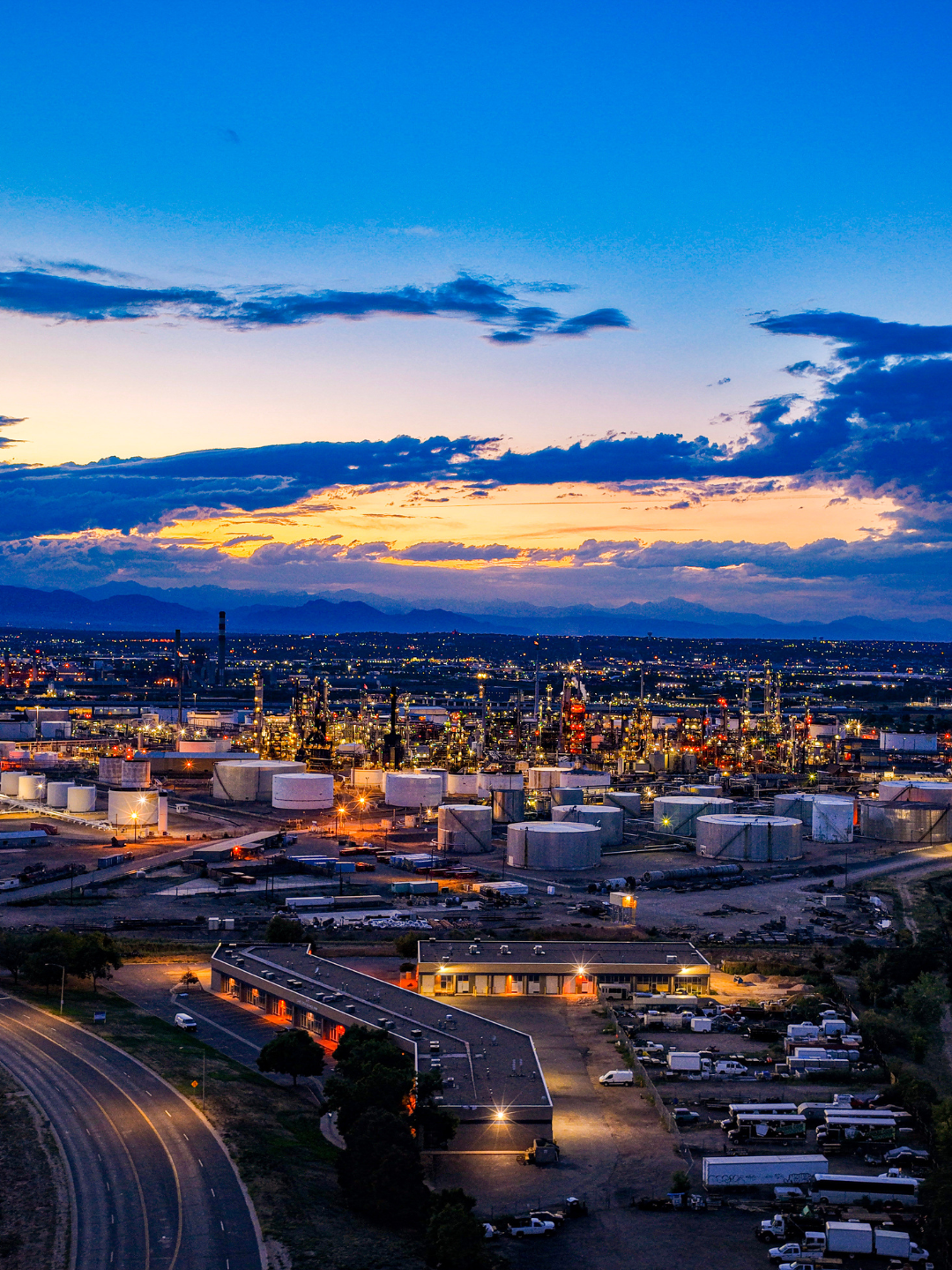
Suncor's Colorado footprint sits along Brighton Boulevard in Commerce City, just north of Denver, where it operates the state's only petroleum refinery. The complex, assembled through acquisitions in 2003 and 2005, runs Denver-Julesburg Basin crude at roughly 98,000 barrels per day and sells nearly 95% of its gasoline, diesel, jet fuel and asphalt within Colorado. Boulder's lawsuit targets the companies' fossil fuel sales and marketing rather than the refinery's local emissions, but the plant carries its own enforcement record that has been building for more than a decade.
Since 2011, state and federal regulators have announced roughly $22.9 million in enforcement actions against the refinery, most of it in required projects rather than cash penalties. The largest, a February 2024 state order totaling $10.5 million, covered sulfur dioxide, carbon monoxide and nitrogen oxide exceedances and requires at least $8 million in power-reliability projects by the end of 2026. Both of this year's black-smoke flaring events, in April and May, were tied to electrical problems, and Suncor reported carbon monoxide and hydrogen sulfide releases above permit limits during the April event.
Several larger matters remain open. A joint EPA and state notice of violation issued in July 2024, citing benzene releases and leaking tanks, has not been resolved, nor has a federal Clean Water Act investigation into releases to Sand Creek.
On Aug. 3, the 10th Circuit revived a citizen suit from GreenLatinos, Sierra Club and 350 Colorado alleging more than 9,000 federal emissions exceedances since 2006. State regulators are also drafting tougher air limits they plan to bring to the Air Quality Control Commission in December, and Denver City Council voted down a $25 million fuel contract with Suncor in May 2025.
A decision is expected by the end of the term in June 2027. A ruling for the companies could end Boulder's case and undercut dozens of others like it. A ruling for Boulder, or a tie, would send the case back to the Boulder County courthouse, where after more than eight years of litigation no court has yet weighed the merits.