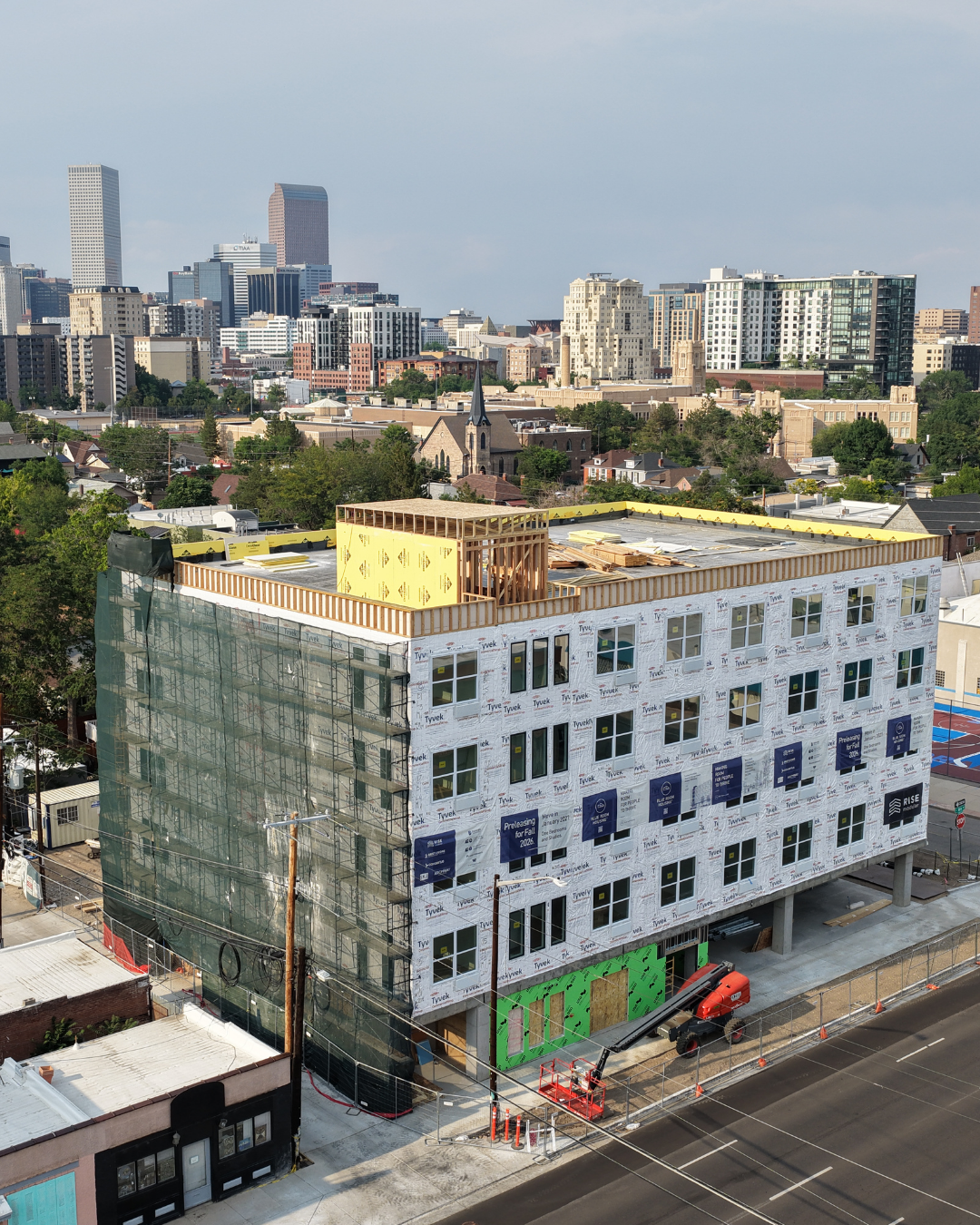
817 W. 8th Avenue
Blue Room Housing and RISE Modular have reached the "setting" milestone at Blue Room House One, the crane-lifted assembly of modular housing units that make up the developer's first project in Denver's Art District on Santa Fe. Crews began stacking prefabricated modules at 817 W. Eighth Avenue and Inca Street this week, and the five-story building could top off at full height within days.
The 54-unit development is designed to serve residents earning between 30% and 80% of area median income, with a particular focus on the artists, educators and service workers who have defined the neighborhood's identity but increasingly struggle to afford to stay in it. The project will also include roughly 3,000 square feet of ground-floor retail and business space beneath a single-story podium deck, and carries an estimated construction cost of $17.35 million.
Blue Room Housing, led by founder Minyoung Sohn, is an impact-first developer built around the idea that modular construction can be a tool for expanding affordability rather than an end in itself. House One is the company's debut project, manufactured by Plymouth, Minnesota-based RISE Modular and designed by Studio K2 Architecture. Bristlecone Construction has led the on-site build since work began in May.
Ground-floor space at House One is being conventionally built, with the four residential floors above assembled from volumetric modules shipped from RISE's factory and lifted into place by crane, unit by unit, module by module. RISE founder and CEO Christian Lawrence said the approach unlocked manufacturing efficiencies and helped the project make the most of a tight urban corner site, adding that the volumetric strategy is expected to shorten total construction time by 30% to 40% compared with conventional stick-built construction.
The pace is becoming a familiar sight in Denver. A month before House One's units started going up, a 77-unit modular apartment project at West Holden Place in Sun Valley, a mile to the west, topped off to its six-story height in just seven days, with its builder estimating construction time savings between 20% and 40% over conventional methods. Together, the two projects point to modular construction's growing footprint in a metro area that state agencies estimate is short more than 106,000 housing units, a gap that would require building roughly 34,100 homes a year to close.
House One's celebration was hosted at the neighboring William E. Cope Boys & Girls Club, where Blue Room presented the organization with a monetary donation in appreciation of its hospitality and its long-running service to local youth and families. Hilary Cooper, director of Innovative Funding for Housing Programs at the state Office of Economic Development & International Trade, said projects like House One help preserve the culture that has made the Art District on Santa Fe a cornerstone of Denver's creative community even as housing costs climb.
Sohn has described House One as a prototype rather than a one-off, with plans to bring the same modular framework to future sites in Denver and across Colorado as the company scales. A recent National Multifamily Housing Council report found that at the current pace of construction, it would take the Denver metro area roughly 93 years to close its affordable housing deficit — a timeline that developers like Blue Room are betting modular construction can meaningfully shorten, one crane lift at a time.