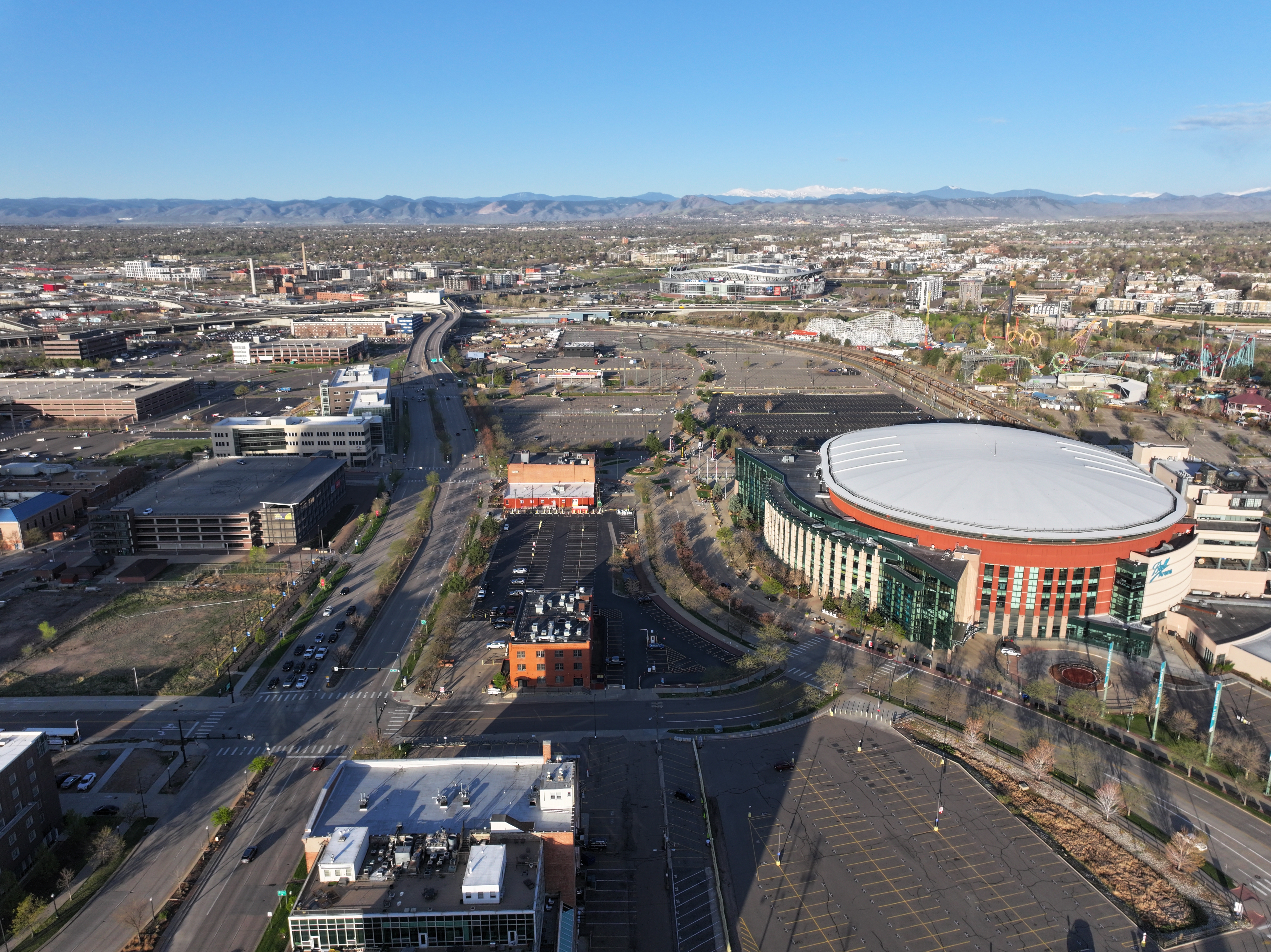
Ball Arena Plan
A proposal to build a pedestrian tunnel serving Ball Arena has been named a finalist in The Boring Company’s international “Tunnel Vision Challenge,” placing Denver among a small group of cities exploring new approaches to underground infrastructure.
The competition drew 487 submissions, narrowed to 16 finalists. Each entry was required to demonstrate a practical use for tunneling that could reduce congestion and improve mobility.
The Ball Arena concept focuses on a familiar pressure point: the surge of foot traffic that accompanies games and concerts at one of the city’s busiest venues.
Though detailed plans have not been released, the proposal centers on a pedestrian tunnel designed to move large volumes of people more efficiently between the arena and nearby destinations. The site sits at the edge of downtown, where event crowds often converge with vehicle traffic and transit lines, creating periodic bottlenecks.
The concept comes despite the presence of the Wynkoop Street pedestrian bridge, which already provides a grade-separated crossing over Wynkoop Street for arena traffic. The proposal suggests an additional layer of infrastructure may still be needed to handle peak event volumes and improve circulation beyond existing solutions.
The concept reflects a narrower, more targeted use of tunneling than some competing proposals, which include vehicle-based systems and freight corridors. By focusing on pedestrian movement, the Ball Arena entry emphasizes feasibility and immediate application, particularly in areas where short-distance congestion disrupts broader circulation.
Judges are evaluating submissions based on utility, cost, and constructibility, with an emphasis on projects that could be realistically built. In that context, the Ball Arena proposal aligns with a growing interest in infrastructure that addresses specific, recurring challenges rather than large-scale, long-range transit systems.
The selection of the Ball Arena concept signals recognition of Denver’s development pressures and the need for solutions that extend beyond surface-level planning. Whether the proposal advances further remains uncertain, but its inclusion in the final round suggests that localized tunnel projects may play a larger role in how cities manage density and movement.